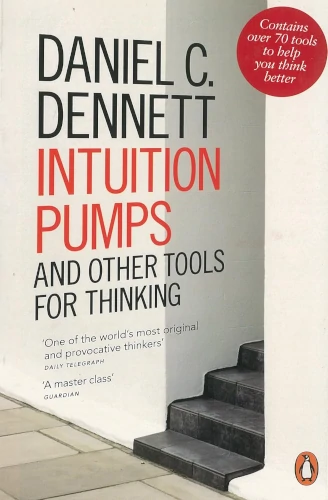
I was revisiting Intuition Pumps and Other Tools for Thinking (2013) by philosopher Daniel C. Dennett - and was interested see that years before constructions like “Not X, but Y” became an indicator of AI writing, he was warning that they could also be a sign of a writer attempting a logical sleight of hand…
“Not X, but Y” - a tell-tale sign of AI…
Wikipedia’s Signs of AI writing reminds us (if we need reminding!) of the widely-known tic of AI-generated text:
Another common LLM pattern is parallelisms that explicitly state that a particular item doesn’t possess the first characteristic at all. Such constructions are often expressed as “It’s not …, it’s …” or “no …, no …, just …”.
Examples
The viewer is presented with a self-image that is not grounded in visual mastery, but in what Amelia Jones terms “the performative enactment of subjectivity”.
[…]
This dispersal is not dissolution. Rather, it constitutes what Deleuze might describe as “becoming” - an identity in flux, constituted through iterative difference. Through this lens, Kusama’s self-portrait is not a mirror but a portal: not a representation of self, but a mechanism for its constant reinvention.
— From this May 2025 revision to Self-portrait (Yayoi Kusama)
…and potential logical legerdemain
But back in 2013 in Intuition Pumps, Dennett was warning us of similar wordings for another reason.
As well as discussing a range of tools which help us think and explore ideas, the book introduces the concept of boom crutches - “thinking tools that backfire, the ones that only seem to aid in understanding but that actually spread darkness and confusion rather than light”. (The term comes from sailing with a completely unrelated meaning, but he explains why he co-opted it here: “I’ve never since been able to think of a boom crutch - a removable wooden stand on which the boom rests when the sail is lowered - without a momentary image of kapow! in some poor fellow’s armpit.”)
And one of these boom crutches, introduced in chapter 9, he calls “rathering”:
Rathering is a way of sliding you swiftly and gently past a false dichotomy. The general form of a rathering is “It is not the case that blahblahblah, as orthodoxy would you believe; it is rather that suchandsuchandsuch - which is radically different”. Some ratherings are just fine; you really must choose between the two alternatives on offer; in these cases, you are not being offered a false, but rather a genuine, inescapable dichotomy. But some ratherings are little more than sleight of hand, due to the fact that the word “rather” implies - without argument - that there is an important incompatibility between the claims flanking it.
In short - an argument like this can be an attempt to dodge the question “Why can’t blahblahblah and suchandsuchandsuch both be true?” For example:
Religion is not the opiate of the masses, a Marx said; it is rather a deep and consoling sign of humanity’s recognition of the inevitability of death.
Yet again, why can’t it be both the opiate and a consoling sign?
And seemingly foreseeing how we now see the construction:
[S]ome ratherings don’t use the word “rather”. Here is one that uses the terser form “___, not ___”…
So now we have two reasons to be careful of “Not X, but Y”!
As for the rest of the book (and subsequent theatre trip)…
Although the front cover of Intuition Pumps boasts that it “Contains over 70 tools to help you think better”, making it sound like a self-help book, its classification on the back cover as “Science/Philosophy” is a better fit. It mostly introduces and uses these tools in an exploration of ideas around evolution, meaning, free will, and consciousness.
I’d coincidentally first read it shortly before I saw Tom Stoppard’s The Hard Problem (2015) at the National Theatre on similar themes and, despite the mixed reviews, enjoyed the two perspectives. The trailer is here:
and for readers with a little more time, there is also a 40-minute discussion between Tom Stoppard and National Theatre Director Nicholas Hytner about the play.